Road trips
East Coast England road trip: unforgettable adventure
)
From North Yorkshire to Norfolk, Whitby to Whitstable, an east coast England road trip is packed with dramatic landscapes and plenty to see and do. The coastal roads around this part of the country take in seaside towns and award-winning beaches, national parks and areas of outstanding natural beauty… making up some of our favourite trips in the UK. Ensure your own east coast England road trip is an awesome one by following our expert guide on the best places to visit.
Best road trip around east coast England: 10 destinations you can’t miss
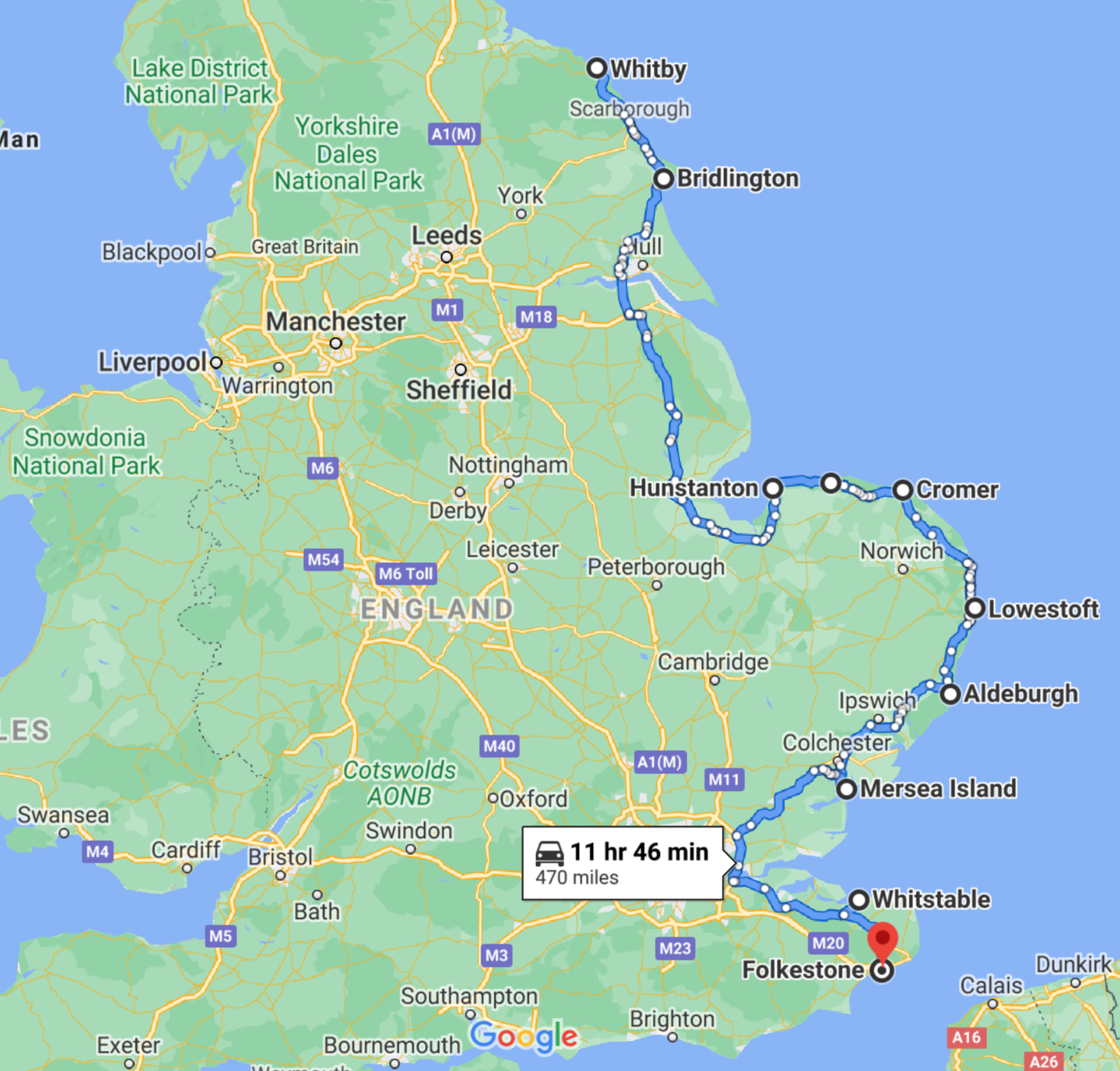
To cover as much as possible of this lovely region, we’ve packed quite a bit into our trip! It starts in North Yorkshire (see our listings forcampervan hire in the North East) and runs for around 470 miles down to Kent, with heaps of optional detours along the way. Yorkshire, Lincolnshire, Norfolk, Suffolk, Essex and Kent all feature on this brilliant adventure.
Driving on direct routes, our east coast road trip covers around 470 miles. But there are lots along the way you won’t want to miss! So we’ve added options for scenic routes between most of our destinations: see each section for details!
Here are our top 10 highlights for a road trip on the English east coast.
1. Whitby

Our east coast road trip starts in the North Yorkshire seaside town of Whitby, easily reached from locations such as Newcastle, Leeds and York (or in 2.5 or 3.5 hours from Manchester and Edinburgh respectively). It’s also just on the edge of the North York Moors National Park if you’d like to take your time getting to the coast.
Whitby is best known for its Dracula legend – this was where author Bram Stoker had Count Dracula landing in England – and these days as the setting of the Whitby Goth Weekend every April and October. Its supernatural legends see a good range of spooky events, such as ghost walks and the Dracula Experience.
The iconic ruin of seventh-century monastery Whitby Abbey is another highlight, as are Whitby Lighthouse, St Mary’s Church, and The 199 Steps which lead from Church Street to views over the harbour. Whitby was also the birthplace of Captain Cook, who has a museum dedicated to him in the town.
2. Bempton Cliffs

After Whitby, drive along the Yorkshire coast to Bempton Cliffs, the setting of the RSPB reserve where around half a million seabirds nest on the chalk cliffs between March and October. This is the biggest seabird colony in England, described by naturalist Chris Packham as the “Nou Camp of the bird world”.
As well as the visitor centre, car park, toilets, café and shop, the reserve has binocular hire, nature trails and guided walks. Be sure to spend some time on the viewing platform to take in the full spectacle: puffins, guillemots and gannets can all be seen on the cliffs, while barn owls and tree sparrows flit over the edging grass and scrubland.
Whitby to Bempton Cliffs is 36 miles on a direct route, but this leg of your road trip is definitely one for detours, as this part of the coast has the seaside resort of Scarborough plus the old fishing village of Robin Hood’s Bay and end of the endpoint of the Coast to Coast route along the way.
You’ll also pass Filey, a seaside resort with a beautiful beach and a setting at the eastern end of the Cleveland Way and the northern end of the Yorkshire Wolds Way. Filey Bird Garden & Animal Park is a great option for kids. Thefull route is only a little bit longer, at 40 miles.
3. Hunstanton

This is the longest leg of the trip, arriving into the county of Norfolk at the purpose-built seaside town of Hunstanton – and again with scenic detours along the way!
Overlooking the estuary of The Wash, Hunstanton is a Victorian resort town with [iconic] red and white striped limestone/chalk cliffs, edging a wide-open beach and clear waters. Explore the town by taking the mile and a half-long Horticultural Trail starting at Hunstanton Town Hall to pass 14 locations including the Esplanade Gardens.
Other options are boat trips to see the grey and common seal colonies on the town’s adjoining sand bars, or using Hunstanton as a base to hike part of the Norfolk Coast Path or bike the Norfolk Coast Cycleway of National Cycle Route 1. Amusements, a funfair and a bowling alley are all at the seafront.
Get from Bempton Cliffs to Hunstanton on a 149-mile journey crossing the Humber and passing Hull to drive south through the Lincolnshire Wolds Area of Outstanding Natural Beauty (AONB). A detour to Lincoln is easily possible on this route too. To visit another famous east English coast destination, drive to Hunstanton via Skegness (170 miles), again via the Lincolnshire Wolds. Both routes pass Bridlington, the largest lobster port in the UK and Europe, and the market town of Beverley just inland.
4. Cromer

Stay on the north Norfolk coast for our next stop, the seaside town of Cromer, “the gem of the Norfolk coast”. Like Hunstanton, Cromer is in the Norfolk Coast Area of Outstanding Natural Beauty, a stunning stretch of coast that’s part of Norfolk’s 40+ miles of golden sandy beaches.
The handsome beach at Cromer is split into two sections by the town’s – West Beach with a funfair, and East Beach which is quieter. Cromer Pier is a destination in itself too for the Pavilion Theatre and the Royal Lifeboat Station, or to go gillying (crabbing) from the end. You might also want to hike part of the Norfolk Coast Path, which passes through Cromer or have a bike day trip on the 92-mile Norfolk Coast Cycleway linking Cromer with Kings Lynn and Great Yarmouth.
The journey fromHunstanton to Cromer is 41 miles, passing beautiful detour destinations like Brancaster Beach with its miles of unspoilt golden sand, and Wells-next-the-Sea, with its lovely beach backed by the Holkham National Nature Reserve. Also stop off at Blakeney Point, home to Blakeney National Nature Reserve and the largest grey seal colony in England.
5. Great Yarmouth

Our route now curls around the coast to eastern Norfolk and another popular seaside town at Great Yarmouth, on a three-mile sandbar between the North Sea and River Yare. The town has two piers, Wellington Pier and older Britannia Pier, which has regular acts in summer at its Britannia Theatre. Stroll the “Golden Mile” seafront for beach access as well as the Pleasure Beach theme park, adventure golf, the Sea Life Centre and Merrivale Model Village.
There’s a strong history vibe at Yarmouth too – take the heritage walk to discover Yarmouth’s medieval city walls (only York has more complete ones), and visit the Time and Tide Museum, Nelson Museum and the Tolhouse Gaol to explore Yarmouth’s rich past. The Maritime Festival in September each year celebrates the town’s maritime heritage.
Although Yarmouth is a destination in itself, we’ve also included it here because of the beautiful Norfolk Broads! The town marks the spot where the Broads flow into the sea and is also the gateway between the Broads' north and south rivers. Head from Yarmouth to Beccles and Loddon to the south, Norwich to the west, or Wroxham and Hickling Broad to the north.
Cromer to Great Yarmouth is 34 miles direct, or 38 miles on a coastal route viaBacton, Sea Palling and Caistor. Don’t forget a detour to Norwich either! It’s 21 miles west from Yarmouth, through the Broads.
6. Lowestoft

A very easy 11 miles for the next leg of the trip, to allow lots of time for seaside or Broads exploring! This stop moves our road trip into Suffolk – from Great Yarmouth to Lowestoft, the most easterly town in the UK and the second biggest town in the county (after Ipswich). As it’s so far east, Lowestoft is the first place in the country to see the sunrise every morning, so pack your camera and plan a dawn picnic on the beach.
Start your sightseeing at lovely Lowestoft Harbour, the most easterly port in the country and with direct access to the North Sea, then spend some time on Lowestoft’s award-winning golden sandy beach or the sands at Kessingland a mile away. Two piers, the award-winning Pleasurewood Hills Theme Park, the Africa Alive! wildlife park and boating on the Broads and the River Waveney are among the many other Lowestoft attractions. There are also three theatres: the Marina, the Players and The Seagull.
7. Aldeburgh

One of the artiest towns in this part of England is Aldeburgh, once the home of composer Benjamin Britten who founded the acclaimed Aldeburgh Festival (now held each June). The Aldeburgh Beach Lookout is now an artists’ and exhibition space, while the town’s shingle beach is the setting of the 15-feet steel sculpture Scallop. The Martello tower is a historic highlight, and The Red House is Britten’s former home, now open for tours.
This is a fishing centre too, so be sure to pick up some of the fresh fish sold daily at the Aldeburgh fisherman huts, or try fish and chips from The Fish and Chip Shop in the High St, described in The Times as “possibly the finest on the east coast”. If you prefer to land your own catch, Aldeburgh is a top spot for bass, cod and eel fishing, plus flounders, sole, dab and whiting.
The 28-mile route fromLowestoft to Aldeburgh enters the Sussex Coast and Heaths Area of Outstanding Natural Beauty, with heaps of quiet spots for picnics or strolls. You could also stop at Southwold, another pretty and well-known Suffolk seaside town.
8. Mersea Island

Next up is Essex, and the ancient little isle of Mersea Island, set on marshland in the estuary area of the Blackwater and Colne rivers. Mersea has been a holiday destination since Roman times and known for its fishing for as long; its oysters are exported all over the world. Head to The Company Shed or The Oyster Bar for locally caught fresh seafood, or visit Mersea in May to sample the wares of the Mersea Island Food, Drink & Leisure Festival in the Mersea Vineyard.
Mersea Island is just seven square miles in area, but there’s quite a bit to do. Boat trips, watersports and shoreside walks are among the available activities, or you could make for the eastern end and the grassland, meadows and sandy beach of Cudmore Grove Country Park. As the area around Mersea is mostly mudflats and saltmarsh, it’s a haven for wading and migratory birds too.
There are a couple of ways to get here – a 52-mile journey fromAldeburgh to Mersea skirting the Dedham Vale AONB, or74 miles staying in the Sussex Coast and Heaths AONB, passing Orford on the way to Felixstowe. Access to the island is by road over the Strood causeway when the tide is out.
Detours are plentiful too! Stop at the small riverside town of Manningtree or the international port town of Harwich just inside the Essex border, have a day in Colchester or Dedham Vale inland, or stay around the coast for Essex seaside towns like Walton-on-the-Naze and Clacton-on-Sea.
9. Whitstable

From one oyster capital to another and our next east coast destination, the seaside town of Whitstable on Kent’s north coast. Like Mersea, oysters have been farmed in Whitstable since Roman times and its harbour is still an essential part of the town and economy. Whitstable now holds an annual Whitstable Oyster Festival every summer and maintains the Crab and Winkle Line bike path from Whitstable to Canterbury along the old railway line.
Other leisure options in Whitstable are watersports from the shingle beaches around the harbour, including jet-skiing from the harbour’s east. Swimming is popular around “The Street” shingle strip exposed at low tide for safe dips in the shallows of this former river valley. Explore the town’s history at Whitstable Castle and Whitstable Museum and Gallery, or via a boat trip from the harbour to the Maunsell forts of World War 2.
Mersea Island to Whitstable is 98 miles, going inland via Chelmsford and crossing the Thames at Dartford. Or travel to Whitstable via the pretty little village of Maldon, then the Kent capital of Rochester (95 miles). You can also visit London on this part of the trip: drive fromMersea Island to Barking, via Brentwood (115 miles).
10. Folkestone

Time for our final stop! Round off your east coast England road trip with a day at Folkestone on Kent’s south and the English Channel coast. This pretty port on the edge of the North Downs is a scenic and arty settlement where the Old Town has developed into the Creative Quarter with independently-run shops, art studios and cafés.
Another highlight is The Leas, a clifftop coastal promenade with spectacular views and sunsets as well as a cliff lift. The Lower Leas Coastal Park has an amphitheatre with free live music throughout the summer. Folkestone also holds a Comic-Con each May, and a Zombie Walk every Halloween.
Get fromWhitstable to Folkestone on a 57-mile coastal route passing Margate, Ramsgate, Sandwich Bay, Deal, Margaret’s Bay and Dover, for several scenic stops as well as access to hikes on Kent’s coastal paths. If you want to go direct, the inland journey fromWhitstable to Folkestone via Canterbury is 31 miles, crossing the Kent Downs AONB.
Organising your east coast England road trip
Ready to start planning your east coast England road trip? If you’re looking to hire a van around Newcastle-upon-Tyne or other convenient starting points, check out our options forcampervan hire in the North East. We also offer plenty of choices forcampervan hire in the East of England too!
Want some more road trip inspiration? Ourroad trips in England guide has heaps of ideas for # vanlife holidays all over the country.
Why Camplify?
We are proud to be the UK’s fastest-growing campervan, motorhome and caravan sharing community. When you hire a van from our platform, you get lots of advantages:
Comprehensive hire insurance
24/7 RAC nationwide breakdown cover
Dedicated customer support
All members are verified
By hiring at Camplify, you are also helping local families who share their van on our platform and supporting many local companies across the UK in addition to ours. So we are very grateful to you.
Sign up if you want to join our beloved community of van life lovers and receive our most recent news and offers.
The information in this blog is accurate and current as of the date of posting. Please be aware that information, facts, and links may become outdated over time.